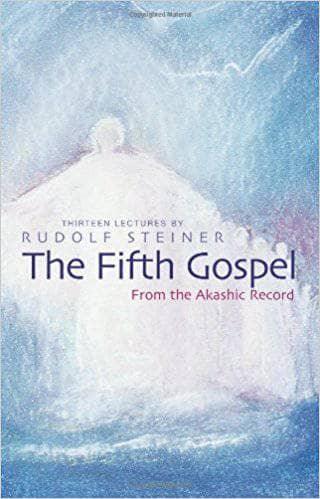
13 lectures, Oslo, Berlin, and Cologne, Oct 1913 to Feb 1914. Translated by Anna Meuss. 264 pages.
From his clairvoyant reading of the akashic record—the cosmic memory of all events, actions, and thoughts—Steiner was able to discuss aspects of the life of Jesus Christ that are not recorded in the four Gospels of the conventional Christian Bible. The results of such research has been called “The Fifth Gospel.”
After an intense inner struggle to verify the exact nature of these events, and having checked the results of his research, Steiner described many detailed episodes from the akashic record. For example, he speaks of Jesus’ life in the community of the Essenes, the temptation of Christ in the wilderness, and a significant, previously unreported conversation between Jesus and Mary.
Steiner states that divulging such spiritual research is intensely difficult, but that “although people show little inclination to be told such facts as these, it was absolutely essential that knowledge of such facts should be brought to Earth evolution at the present time.”
The "Fifth Gospel" by Rudolf Steiner is a collection of lectures revealing aspects of Jesus' life not covered in the traditional Gospels, based on clairvoyant readings of the akashic records.
Who translated "The Fifth Gospel" by Rudolf Steiner?
The book was translated by Anna Meuss, ensuring the lectures are accessible to English-speaking audiences.
What are some key topics covered in "The Fifth Gospel"?
The book discusses Jesus' life with the Essenes, the temptation in the wilderness, and a unique conversation with Mary, among other insights.
Why did Rudolf Steiner believe sharing the "Fifth Gospel" was essential?
Steiner felt it was essential to share these spiritual insights to advance human understanding and evolution, despite the challenges in conveying them.
Choosing a selection results in a full page refresh.